Wednesday, 28 May 2014
Bus Stop Chair at Glangrwyney
Here's a chair I wombled from a skip, now available for bus travellers on the A40 at Glangrwyney, near Abergavenny.
This chair had clearly been outside for a while and had acquired the greyness, a patina synonymous with much accidental garden furniture. I decided to keep the outdoor theme and cover it in a discarded painting of a river by my excellent wife.
And in celebration of the coming World Cup I went for a 1970's Super Striker figure.
Come on England.
Monday, 26 May 2014
Ikea sofas in Bute tweed
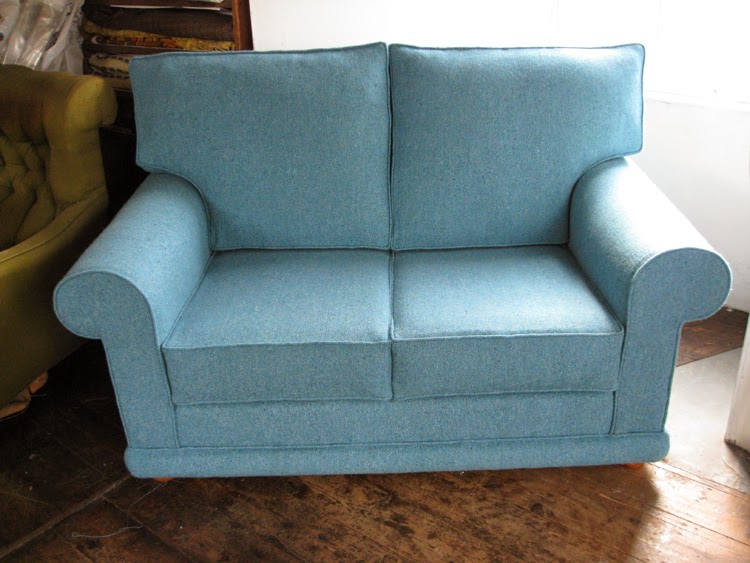
A pair (honestly it's not two photos of the same one) of 1990 IKEA sofas reupholstered in fantastic Bute tweed.
Who says IKEA make cheap, poor quality furniture? Ok, I probably do - me and most other upholsterers I suspect. I tried to discourage this customer from having these done saying 'you can probably buy a new one for much less money', but they were adamant that they couldn't find anything comparable either new or second hand so I had a look and after taking the bottom off realised that underneath the fabric they were still in pretty good condition.
It turns out these sofas were actually made in the UK by Buoyant Upholstery and after 20+ years of family life, the seat cushions were almost as new and the backs weren't too bad either. Solid pine, some chipboard and some fibreboard made a pretty solid frame - no worse than many manufacturers who claim to make 'traditional' furniture. I don't know if IKEA are still using UK manufacturers, but fair play to them if they are.
I just added some polyester wadding and with the Bute fabric the customer bravely chose I'm certain they'll get another 20+ years use from these.
And thanks to the Bute wool they're a damn sight more stylish, even if I do say so myself.
Wednesday, 21 May 2014
Milking Stools in Welsh wool
Ash milking stool in Melin Tregwynt St. David's Cross wool
Late 19th Century sycamore milking stool in Melin Tregwynt St. David's Cross wool
I reckon these are pretty cool, bordering on cute but cool nonetheless.
Yours for £95 - would look really excellent in your living room near the telly.
Tuesday, 20 May 2014
Footstools in Welsh Wool
1930's oak footstool in Melin Tregwynt Carew wool
£75
Long painted footstool in Melin Tregwynt St.David's Cross lambswool
£125
Friday, 11 April 2014
Back to college
Working alone is great. No-one whingeing-on about their
workmates; no-one to notice you’re late back from the pub at lunchtime, no-one
to get fed up listening to the loud ugly music you love so much. But there is
also no-one to learn from, no-one to show you quicker or better ways to do
things. And before you know it you are set in your ways. You are marooned on an
island of your own methods. You are not progressive.
After three years of full time working alone I decided I’d
better get some new influence and determined that every year I must either go
to college or work with another upholsterer (and not just Dave up the road). So
with the help of a Welsh Government grant (that I qualified for on a delicious
technicality) I booked myself 3 weeks at the Traditional Upholstery Workshop,
practically on my doorstep, here in Carmarthenshire.
As a second generation upholsterer I was taught mainly by my
dad and while he was a great upholsterer, he wasn’t a great teacher. When I
asked questions he would look at me as though I were an idiot and say ‘give it
here,’ and just do it himself. He could show me how to do anything but wasn’t
able to explain in words. So over the years I signed up with a number of
different teachers in London, Yorkshire and Wales. They were mainly hobby
classes but I’d go week after week and year after year and with the help of a
few books and my dad’s ‘use your brain and just work it out’ philosophy, I
slowly pieced things together. But I’m far from an expert in traditional
methods so the Traditional Upholstery Workshop was ideal – their reputation
told me that foam was the F word and should never be uttered, and that Messrs
Horse-Hair and Hessian would be my new friends. So I packed up a half-made
chair for one of my customers and off I went.
Week One
Talk about self
conscious. I’m supposed to be a professional and I seem to do everything
wrong. I don’t do upholstery like this at all. I regulate through the scrim, this way feels like grooming a monkey. Surely I
don’t need to mark out my stitches? And surely that’s a tight enough edge roll?
What do you mean I have to unpick it and do it again?
By day three I have stabbed myself with a regulator so many
times that I am applying plasters on top of plasters and wondering if my
Tetanus jab is up to date. Everyone is lovely, but I’m keeping my head down,
feeling not very professional at all.
By day five I have made the most perfect and beautiful seat
possible. As I look at it I realise I am changed. I have learned.
Week Two
Traditional upholstery is beautiful. And then we cover it up
in fabric. It is a dark-art known only by the initiated and customers have no
idea of the skill and time it takes. I decided to use the luxury of
learning-time to make some samplers to show my customers what it’s like underneath.
I took two small picture frames, webbed them and stitched them to
first-stuffing stage. One with an edge roll and one with a feathered edge. This
took me three and a half days. I
think the other students thought I was mad, particularly when, upon finishing I
exclaimed “I appear to have made a pair of pork pies.”
They’re great though. I’ve showed them to a few friends and
customers and each time the reaction has been a genuine ‘wow’.
I also made some of this bench using a fantastically
expensive linen scrim that I’ve only ever seen in books. A huge pleasure to
work with, and by now, having stitched and unpicked my little samplers so many
times, I’m getting much better at making seat pads, quite good even.
Week Three
Apart from improving at stitching hair pads, the other thing
I wanted to learn was a Van Dyke Join. This is the seemingly impossible and
mysterious art of joining fabric when deep buttoning. I’d never done it before
because I’ve never had to make a piece of buttoned furniture large enough to
warrant it (I have done a Chesterfield but not with buttons). And it looks so
complicated in the books. Given the time available, I decided to make a deep
buttoned stool in the traditional way and put a join in the fabric just for the
sake of it.
It turned out to be one of the most simple tasks of all,
which is more than can be said for my newly-learned deep buttoning technique of
fastidious pinning and checking and un-pleating and re-pleating and not-rushing
and making-sure-that-everything-is-perfect-at-every-stage.
I am so happy with this daft little pad that I’m keeping it detached from its rather ugly legs and hanging it in the workshop to be handed to people from time to time with the boisterous question “Can you see the join? No, didn’t think so.”
The Traditional Upholstery Workshop is excellent. It has
exactly the right environment for proper learning. It is AMUSF accredited and
most of the students are intending to carry out upholstery on a professional
basis. Indeed, the past alumni are testament to this. There is exactly the
right mix of having a chat with your benchmates and getting on with your work.
With only 5 students to 2 teachers you never have to wait for attention.
And
most importantly of all, the teachers Liz and Emily are both genuine experts.
When you ask hopefully if your edge-roll is tight enough, Liz will quietly put
on her leather gloves, unpick two stitches and with a tiny regulator somehow
drag just the right amount of stuffing forward and say “It is now.”
It is one thing to be told how to do something but another
thing altogether to be shown.
Thursday, 10 April 2014
1920's Tub Chairs in Sanderson Wool
A pair of 1920's oak tub chairs reupholstered in Sanderson Woodford Check Sage.
I was determined to cover the backs in a single piece of fabric so that the checks weren't interrupted (you're supposed to do tub chairs in 3 pieces) and after a couple of attempts I worked out how to do it. I then had to match the seat up - not easy when working with a pre-stitched front skirt. It took a while...
I love making pairs of identical chairs - you have to complete each stage to both chairs before moving on, so you have two inside backs, then two seats, then two outside backs, etc - it seems to take ages and then suddenly you've done two jobs instead of one.
Can't be bad.
This was a commission.
Tuesday, 18 March 2014
Bus Stop Chair near Caio, Carmarthenshire
A now-comfortable bus stop on the A482 at the Caio turn-off.
Again the chair came from a skip and was covered in a scrap of 1970's patchwork print in a lovely nylon.
Embellished as ever with a plastic toy, this time an excellent monster-thing.
And why not?
(You might notice how good the photography is - I was accompanied by press photographer Aled Llywelyn, thanks Aled for use of these pics)
Again the chair came from a skip and was covered in a scrap of 1970's patchwork print in a lovely nylon.
Embellished as ever with a plastic toy, this time an excellent monster-thing.
And why not?
(You might notice how good the photography is - I was accompanied by press photographer Aled Llywelyn, thanks Aled for use of these pics)
Saturday, 15 March 2014
Pair of dining chairs in cow hide
A pair of early 20th Century dining chairs reupholstered in a fabulous fluffy cow hide.
From a distance, these look like leather, but as you approach they get hairier and hairier. The calf's licks on the seats are terrific.
This was a commission
From a distance, these look like leather, but as you approach they get hairier and hairier. The calf's licks on the seats are terrific.
This was a commission
Tuesday, 11 March 2014
Wing-back Armchair in Welsh Wool
An 1891 wing-back armchair reupholstered in Melin Tregwynt Mondo Sage doublecloth.
This armchair wasn't looking too great when it came into the workshop.
It came from a stately home in Scotland and was manufactured by a company called Morison & Co in Edinburgh in 1891.
I know it was 1891 because there's an inscription in pencil on an inner rail that reads "John Ferguson, Upholsterer, 1891".
It's a very high quality piece of furniture and had to be reupholstered in the traditional way.
This was a commission.
This armchair wasn't looking too great when it came into the workshop.
It came from a stately home in Scotland and was manufactured by a company called Morison & Co in Edinburgh in 1891.
I know it was 1891 because there's an inscription in pencil on an inner rail that reads "John Ferguson, Upholsterer, 1891".
It's a very high quality piece of furniture and had to be reupholstered in the traditional way.
This was a commission.
Thursday, 6 March 2014
Cool Commode
Being British, we can't help giggling at anything to do with toilets, but this chair is no laughing matter.
A 1960's commode in full working order, reupholstered in an excellent Bute Fabrics tweed.
This is for a customer for whom I've done quite a few projects. She wanted to keep her commode but update it and make it fit in with everything else. Choosing a very bright tweed has certainly done that. Hand-stitched to a piped edge, this is now looking very smart, even if I say so myself.
And if you do want to go to the toilet in the middle of the night...
(This was a commission)
Wednesday, 5 March 2014
1880's Nursing Chair
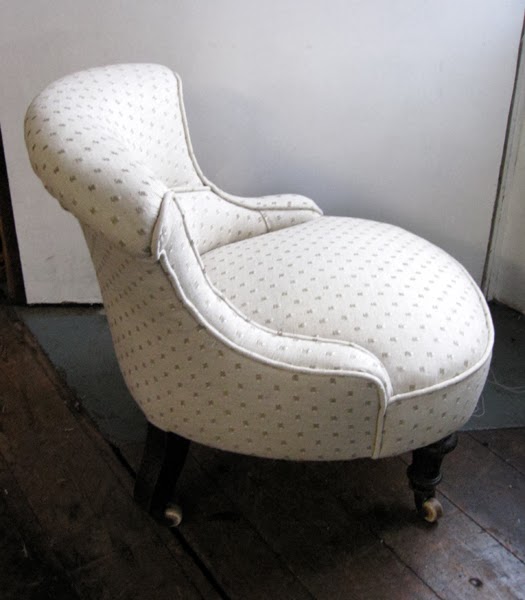
Traditionally reupholstered 1880's nursing chair (small) in Sanderson fabric.
Despite looks, this isn't an iron-back chair, so I didn't have to do all that back-stitching.
It is pretty tiny but will certainly accommodate an adult backside.
This was a commission.
Monday, 17 February 2014
Bus Stop Cushion at Gelli Aur
A 3 metre-long cushion for bus travellers on the A40 at Gelli Aur.
I usedmaterial scraps in red/pink/purple to match the bus shelter - these things are important you know.
Monday, 10 February 2014
Box Cushions
Two sets of box cushions this week - a set of seven piped-edge cushions for a conservatory suite and a set of plain box for a camper van.
I do enjoy sewing but now I want to stop.
Friday, 24 January 2014
1960's Icelandic Chair in Bute Tweed
A 1960's armchair made by Icefurn reupholstered in Bute Turnberry tweed.
This chair was manufactured by Icefurn and designed by Th. Gudmundsson (see labels below attached to underside rail). The customer remembers this being something to do with a business venture between his father and an Icelandic colleague, probably in the 1960's. If anyone can shed any light on the origin of the chair, please get in touch.
The chair came to me in the worst state imaginable, my customer having found it in his dad's barn where it was being lived in by rats. Before I got my hands on it, it looked like this:
As it was so bad, I made one of my daft little films of the restoration project, here it is for your viewing delight.
This was a commission.
Subscribe to:
Posts (Atom)