Monday, 18 August 2014

The Last Gallery


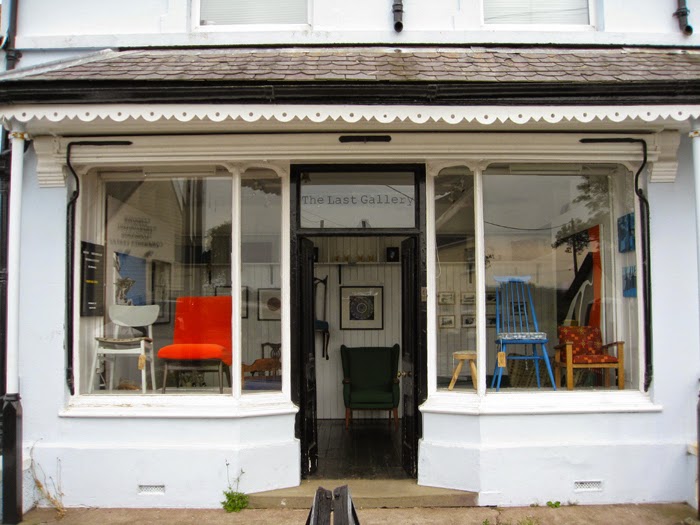
In addition to my upholstery and the myriad other things I seem to do, I am involved in running (and owning) a contemporary art space -  The Last Gallery in Llangadog with my wife, artist Julie Ann Sheridan


After six years running the space we felt we needed a break so we took a sabbatical this year and are still pondering our next move. In the interim I have moved some of my furniture in alongside artwork by Julie, Claire Spencer and Roger Lougher.


The gallery is usually open 9-5 whenever I'm in the workshop, excluding lunchtimes when I tend to walk the dog. Why not come over for a look?


Saturday, 9 August 2014

Footstools in Melin Tregwynt fabric


Kidney-shaped stool in Carew Aqua lambswool


£50


Antique footstool in Tote Pink lambswool


£50

Fifty quid? Can't be bad.


Reupholstery of the pink stool revealed a previous owner who had written their address on the calico, the stool was owned by Mrs.H Smart of 40 Emlyn Rd, Stamford Brook, London NW2.

If this is you I would be very happy to give you your stool back upon production of two forms of identification (driving licence, utility bill, etc).

Friday, 8 August 2014

Ercol Armchair in Bute wool fabric


A 1970's Ercol 'Tall Back Easy Chair (478)' in the Old Colonial dark wood, recovered in Bute Troon dogtooth fabric.


Very smart.

This was a commission.

Monday, 28 July 2014

Victorian Chaise Longue


A Victorian chaise longue reupholstered in Sanderson cerise velvet.


I reckon velvet is right for a chaise longue, it's regal enough and French enough. Napoleon is purported to have said "a throne is only a bench covered in velvet" and this velvet covered bench would have been ideal for him - the base is 5' 7", exactly his height.


And bright pink would suit Napoleon fine, don't you think?


I bet Napoleon loved pink. My customer did anyway.

This was a commission.

Monday, 14 July 2014

Bus Stop Chair at Y Groes, Powys.


An ugly but comfortable chair now available to bus travellers on the A483 at Y Groes, Powys.


This chair came free with a bunk bed I bought for my daughter. Although sturdy it has no aesthetic qualities of any description. So to celebrate this odious 1990's greasy-pine farmhouse pastiche I used a horrible jungle-print velvet stripped from a customer's sofa, cheapo brass nails...


...and a really horrible plastic spider on the leg.

And why not?

Tuesday, 8 July 2014

1920's bergere suite in Bute wool


A 1920's bergere suite with double-sided canework now reupholstered in Bute tweed.


This is a high quality suite was manufactured by Beresford and Hicks of Curtain Rd, London, in the heart of what was then the 'upholstery district' in East London. The space is now occupied by SCP no less.


This had been kept in a barn for the last year or so - getting the spider's webs and mould out from between the canework took some time. The back cushions are fixed in a way I've never seen before so reupholstery took some working out, but the customer wanted the backs to keep their 'feather look' so they're made with rubberised hair and cotton wadding for a puffed-up look.


Nice arm detail.


This was a commission.

Friday, 4 July 2014

Kids car seat in Eleanor Pritchard wool


With an offcut from this project I made my daughter a very fashionable cover for her car booster seat.


She is WELL PLEASED.

Thursday, 3 July 2014

Prince of Wales investiture chair

Here's my dog Lewis on a Prince of Wales investiture chair that I reupholstered for a customer. For the monarchists among you it may seem inappropriate to have a dog on the chair but unlike the Prince the dog is actually Welsh, so some might say he is well qualified to sit on it...


Designed by Lord Snowdon and used by royals and other notable attendees of The Prince Wales’s 1969 investiture ceremony at Caernarfon Castle, the investiture chair was manufactured by Remploy and was made of a vermillion stained plywood and supposedly covered in Welsh wool. This is why the customer brought it to me hoping I could source more Welsh wool for it.

To try to trace the original fabric I contacted lots of Welsh mills and other people in the know but drew a blank, no-one had any idea who produced the wool fabric. When I finally got the chair I realised it wasn't covered in wool at all, but a cotton/polyester mix with textured weave. I could find nothing suitable produced in Wales but found an ok match from Scottish manufacturer Wemyss

**UPDATE - JAN 2016 - Lots of people have contacted me since asking if I can source a fabric for these chairs so I got in touch with CADW and various other organisations including St.Fagan's and still no joy. If anyone does have a source please let me know. Until then I'm recommending Danish manufacturer Kvadrat and their Tonus fabric. It's expensive at over £100 per metre (min order 1m) but if you can bring your chair to me for reupholstery I can supply this about half price because it only needs half a metre. Hope this helps. Mick.

***UPDATE - APRIL 2016 - I now have the original fabric in stock and can supply it - see this blog post for details 

So if you have one of these and it needs reupholstering, it looks like I'm your man.

Just don't tell Charles about the dog.

Monday, 16 June 2014

Art Nouveau armchair in Welsh wool


An Art Nouveau/Arts & Crafts armchair reupholstered in Melin Tregwynt St. David's Cross wool.


In terms of style this chair falls between the Arts & Crafts movement and the Art Nouveau movement and takes aspects of both styles. Mainly beech with inlaid walnut arms.

What a beauty.

Yours for £195

Tuesday, 3 June 2014

Ercol Suite in Eleanor Pritchard wool fabric

An Ercol Windsor suite in Eleanor Pritchard Totley 100% wool.


Once again, brilliant customers who are prepared to take risks - they wanted a single bench seat on the two-seater to make it more contemporary (which I think is a brilliant idea) and allowed me to convince them to ditch the fitted back cushion shapes so that the spindles are more exposed.


The fabric is astonishing - probably the best quality fabric I've ever used. The customers are from London and asked specifically for this fabric - I couldn't believe my luck because I've been following Eleanor Pritchard's career for quite a while and when she recently came up with an upholstery range I was all over it. It's woven in Scotland but is from a very Welsh tradition, it's a doublecloth with reverse colouring on each side - my favourite. We used the reverse on the backs of the feather cushions...


...and reversed it again for the armchair.


Just look at it.

Want one of these?

Yes, I thought so.


Wednesday, 28 May 2014

Bus Stop Chair at Glangrwyney


Here's a chair I wombled from a skip, now available for bus travellers on the A40 at Glangrwyney, near Abergavenny.


This chair had clearly been outside for a while and had acquired the greyness, a patina synonymous with much accidental garden furniture. I decided to keep the outdoor theme and cover it in a discarded painting of a river by my excellent wife.


And in celebration of the coming World Cup I went for a 1970's Super Striker figure.


Come on England.

Monday, 26 May 2014

Ikea sofas in Bute tweed


A pair (honestly it's not two photos of the same one) of 1990 IKEA sofas reupholstered in fantastic Bute tweed.


Who says IKEA make cheap, poor quality furniture? Ok, I probably do - me and most other upholsterers I suspect. I tried to discourage this customer from having these done saying 'you can probably buy a new one for much less money', but they were adamant that they couldn't find anything comparable either new or second hand so I had a look and after taking the bottom off realised that underneath the fabric they were still in pretty good condition.


It turns out these sofas were actually made in the UK by Buoyant Upholstery and after 20+ years of family life, the seat cushions were almost as new and the backs weren't too bad either. Solid pine, some chipboard and some fibreboard made a pretty solid frame - no worse than many manufacturers who claim to make 'traditional' furniture. I don't know if IKEA are still using UK manufacturers, but fair play to them if they are.

I just added some polyester wadding and with the Bute fabric the customer bravely chose I'm certain they'll get another 20+ years use from these.


And thanks to the Bute wool they're a damn sight more stylish, even if I do say so myself.


Wednesday, 21 May 2014

Milking Stools in Welsh wool


Ash milking stool in Melin Tregwynt St. David's Cross wool


Late 19th Century sycamore milking stool in Melin Tregwynt St. David's Cross wool


I reckon these are pretty cool, bordering on cute but cool nonetheless.

Yours for £95 - would look really excellent in your living room near the telly.


Tuesday, 20 May 2014

Footstools in Welsh Wool


1930's oak footstool in Melin Tregwynt Carew wool

£75


Long painted footstool in Melin Tregwynt St.David's Cross lambswool


£125

Friday, 11 April 2014

Back to college


Working alone is great. No-one whingeing-on about their workmates; no-one to notice you’re late back from the pub at lunchtime, no-one to get fed up listening to the loud ugly music you love so much. But there is also no-one to learn from, no-one to show you quicker or better ways to do things. And before you know it you are set in your ways. You are marooned on an island of your own methods. You are not progressive.

After three years of full time working alone I decided I’d better get some new influence and determined that every year I must either go to college or work with another upholsterer (and not just Dave up the road). So with the help of a Welsh Government grant (that I qualified for on a delicious technicality) I booked myself 3 weeks at the Traditional Upholstery Workshop, practically on my doorstep, here in Carmarthenshire.

As a second generation upholsterer I was taught mainly by my dad and while he was a great upholsterer, he wasn’t a great teacher. When I asked questions he would look at me as though I were an idiot and say ‘give it here,’ and just do it himself. He could show me how to do anything but wasn’t able to explain in words. So over the years I signed up with a number of different teachers in London, Yorkshire and Wales. They were mainly hobby classes but I’d go week after week and year after year and with the help of a few books and my dad’s ‘use your brain and just work it out’ philosophy, I slowly pieced things together. But I’m far from an expert in traditional methods so the Traditional Upholstery Workshop was ideal – their reputation told me that foam was the F word and should never be uttered, and that Messrs Horse-Hair and Hessian would be my new friends. So I packed up a half-made chair for one of my customers and off I went.

Week One

Talk about self conscious. I’m supposed to be a professional and I seem to do everything wrong. I don’t do upholstery like this at all. I regulate through the scrim, this way feels like grooming a monkey. Surely I don’t need to mark out my stitches? And surely that’s a tight enough edge roll? What do you mean I have to unpick it and do it again? 

By day three I have stabbed myself with a regulator so many times that I am applying plasters on top of plasters and wondering if my Tetanus jab is up to date. Everyone is lovely, but I’m keeping my head down, feeling not very professional at all. 

By day five I have made the most perfect and beautiful seat possible. As I look at it I realise I am changed. I have learned.


 Week Two

Traditional upholstery is beautiful. And then we cover it up in fabric. It is a dark-art known only by the initiated and customers have no idea of the skill and time it takes. I decided to use the luxury of learning-time to make some samplers to show my customers what it’s like underneath. I took two small picture frames, webbed them and stitched them to first-stuffing stage. One with an edge roll and one with a feathered edge. This took me three and a half days. I think the other students thought I was mad, particularly when, upon finishing I exclaimed “I appear to have made a pair of pork pies.”


They’re great though. I’ve showed them to a few friends and customers and each time the reaction has been a genuine ‘wow’.

I also made some of this bench using a fantastically expensive linen scrim that I’ve only ever seen in books. A huge pleasure to work with, and by now, having stitched and unpicked my little samplers so many times, I’m getting much better at making seat pads, quite good even.


Week Three

Apart from improving at stitching hair pads, the other thing I wanted to learn was a Van Dyke Join. This is the seemingly impossible and mysterious art of joining fabric when deep buttoning. I’d never done it before because I’ve never had to make a piece of buttoned furniture large enough to warrant it (I have done a Chesterfield but not with buttons). And it looks so complicated in the books. Given the time available, I decided to make a deep buttoned stool in the traditional way and put a join in the fabric just for the sake of it.


It turned out to be one of the most simple tasks of all, which is more than can be said for my newly-learned deep buttoning technique of fastidious pinning and checking and un-pleating and re-pleating and not-rushing and making-sure-that-everything-is-perfect-at-every-stage.


I am so happy with this daft little pad that I’m keeping it detached from its rather ugly legs and hanging it in the workshop to be handed to people from time to time with the boisterous question “Can you see the join? No, didn’t think so.”


The Traditional Upholstery Workshop is excellent. It has exactly the right environment for proper learning. It is AMUSF accredited and most of the students are intending to carry out upholstery on a professional basis. Indeed, the past alumni are testament to this. There is exactly the right mix of having a chat with your benchmates and getting on with your work. With only 5 students to 2 teachers you never have to wait for attention. 

And most importantly of all, the teachers Liz and Emily are both genuine experts. When you ask hopefully if your edge-roll is tight enough, Liz will quietly put on her leather gloves, unpick two stitches and with a tiny regulator somehow drag just the right amount of stuffing forward and say “It is now.” 

It is one thing to be told how to do something but another thing altogether to be shown.